- 9 P in the S S.
- 1760 Y in a M.
- 640 A in a S M.
- 6.0221415×10²³ A in a M.
- 52 C in a D of P C.
- 206 B in the H B.
Showing posts with label high school. Show all posts
Showing posts with label high school. Show all posts
Monday, June 7, 2010
X = Y in a Z (Part 1)
There have been a few of these types of puzzles on The Puzzle Page in the past, including: 12 I in a F, 12 N on the F of a C, and 3 F in a Y. Here are a few more of the same type.


Friday, June 4, 2010
Find the Furniture
There are five pieces of furniture hidden in the grid below. Link the letters of each piece with horizontal, vertical, or diagonal lines. All 25 letters must be used, no letter may be used more than once, and no line may cross another.
L  E  A  R  D
B  C  H  I  R
A  C  U  B  A
T  B  P  O  O
E  D  S  F  A
Wednesday, June 2, 2010
Simple Crypt-Addition
Here are four different arithmetic crypt problems for you to figure out. Each letter represents a different digit, and each problem is independent from each other problem. These are simple enough that you should be able to figure them out in your head, which means that they should also be great for introducing young puzzlers to cryptographic math puzzles.
Y
Y
+ Y
MY
XXX
+ B
BAAA
ON
ON
ON
+ ON
GO
MA
+ A
AM
For more puzzles like this get Brainteasers and Mindbenders by Ben Hamilton.
Y
Y
+ Y
MY
XXX
+ B
BAAA
ON
ON
ON
+ ON
GO
MA
+ A
AM
For more puzzles like this get Brainteasers and Mindbenders
by Ben Hamilton.Friday, May 28, 2010
Visiting the Mall
Bill, Chuck, Sally, and Dave all went to the mall together last week and entered at the same set of doors between Lord & Taylor's and Abercrombie & Fitch. Dave wanted to go to the information booth to find out if he could buy mall gift certificates, Bill was hungry and said he needed to get something to eat at the snack bar, and Sally and Chuck needed to use the restrooms.

Can you draw a line from each person to their destination so that no two lines touch or intersect?

Can you draw a line from each person to their destination so that no two lines touch or intersect?
Wednesday, May 26, 2010
The Two Trains
Henry Dudeney recalls, "I put this little question to a stationmaster, and his correct answer was so prompt that I am convinced there is no necessity to seek talented railway officials in America or elsewhere.
Two trains start at the same time, one from London to Liverpool, the other from Liverpool to London. If they arrive at their destinations one hour and four hours respectively after passing one another, how much faster is one train running than the other?"
Two trains start at the same time, one from London to Liverpool, the other from Liverpool to London. If they arrive at their destinations one hour and four hours respectively after passing one another, how much faster is one train running than the other?"
Tuesday, May 25, 2010
A Strange Safari - Part 2
Earlier in the month we posted a puzzle about Professor Egghead's Australian safari where he, sadly, did not see any animals other than horses and people on his first day. Luckily the professor did get a chance to see animals on his second day of safari.
After the second day Professor Egghead called me again and this time he was happy to announce that he had seen real wildlife while out riding the horses. I asked him how many animals he had seen and, again, he didn't remember the exact number of all the animals, but he did remember that, including the horses and people from the day before, there were a total of 52 eyes and 74 legs.
If there were twice as many 4 legged dingoes as there were 2 legged ostriches, how many of each wild animal did the professor see?
(You'll have to be a bit creative to get the right answer to this one.)
After the second day Professor Egghead called me again and this time he was happy to announce that he had seen real wildlife while out riding the horses. I asked him how many animals he had seen and, again, he didn't remember the exact number of all the animals, but he did remember that, including the horses and people from the day before, there were a total of 52 eyes and 74 legs.
If there were twice as many 4 legged dingoes as there were 2 legged ostriches, how many of each wild animal did the professor see?
(You'll have to be a bit creative to get the right answer to this one.)
Monday, May 24, 2010
The Professor's Wooden Measuring Stick

What is the fewest number of marks the professor could make on the stick so that he could still accurately measure any whole number length from 1 inch to 10 inches? For instance, placing a mark 1 inch from one end would allow the professor to measure 1 inch and 9 inches.
Monday, May 17, 2010
Mutab, Neda, and Sogal

Today's puzzle comes from an old copy of Best of Creative Computing, Volume 1. In 1976, Walter Koetke, of Lexington High School presented the following:
If you think you've seen this problem before, you may be correct. It's a really old problem in a new disguise.
The civilizations of three planets Neda, Mutab, and Sogal have agreed to begin war in the year 2431. Although these societies have not eliminated such irrational actions as war, they have at least formalized the process. There are, for instance, no guerrilla activities and wars are usually very brief and always decisive. Wars are fought with inter-planetary rockets each of which is powerful enough to completely destroy an entire planet. With such powerful weapons at their disposal, Neda, Mutab, ad Sogal have agreed to the following set of rules, for only in this way can they be assured of a single victor.
Rule 1: The fight will continue until only one civilization remains.
Rule 2: The rather primitive technique of drawing lots will be used to determine which planet may launch the first rocket, which the second, and which the third.
Rule 3: After launching rotation is established, rocket launching begins and continues in order until only one planet remains.
When contemplating the outcome of this war, the three civilizations have full knowledge of the background of their adversaries.
Mutab is clearly the technologically superior civilization. Once launched, their rockets always strike with perfect accuracy - thus disproving a modern theory that nothing is perfect. Before the war begins, both of the other civilizations are aware of the terrifying fact that if a Mutab rocket is fired at them, the probability of their being completely destroyed is 1.
Neda is the oldest civilization and long ago had the superior technology. However, the complacency of a self-centered, unchallenged mind has been eroding this superiority for many years. As a result, the technology of Neda has not advanced in over 40 years. If a Nedian rocket is fired at another planet, the probability of hitting that planet is 0.8, just as it was 40 years ago.
Sogal is by far the newest of the three civilizations. Being dedicated to producing its own technology on its own terms has resulted in a proud and purposeful civilization, but one that is technologically four or five hundred years behind its present adversaries. A missile launched by Sogal has only a 50-50 chance of reaching its intended target.
Your role in this future war is to determine each civilization's probability of winning.
Thursday, May 13, 2010
Binary Primes
The non-blog version of The Puzzle Page has published a new binary crossnumber puzzle. This is similar to another binary crossnumber puzzle posted on this blog earlier.
As with the previous puzzle, the object of this one is to fill the 16 squares with the appropriate binary numbers. If you need a refresher on how decimal numbers compare to binary numbers DEW Associates Corporation has a very nice number conversion chart on their website.
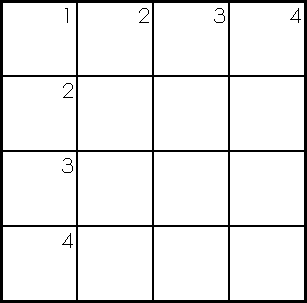
Across
1. 4 Across - 4 Down.
2. A multiple of 3.
3. Same as 1 Down.
4. A prime number.
Down
1. A prime number.
2. Twice the value of 3 Across.
3. 4 Across - 2 Down.
4. A prime number.
Hint: The three prime numbers (4 Across, 1 Down, and 4 Down) are unique.
If you like crossnumber puzzles consider these books from Amazon:
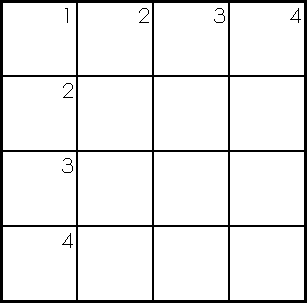
1. 4 Across - 4 Down.
2. A multiple of 3.
3. Same as 1 Down.
4. A prime number.
Down
1. A prime number.
2. Twice the value of 3 Across.
3. 4 Across - 2 Down.
4. A prime number.
Hint: The three prime numbers (4 Across, 1 Down, and 4 Down) are unique.
- 40 Cross-Number Puzzles: Addition & Subtraction
- 40 Cross-number Puzzles: Multiplication & Division (40 Cros-number Puzzles)
- Crossnumber Puzzles: Boosting Skills to Meet Assessment Goals (Crossnumber Puzzles, Grade 6: Extended Skills)
- Crossnumber Puzzles: 50 Crossnumber Puzzles With Solution Guides And Solutions
Wednesday, May 12, 2010
Thirds and Differences
Here's a nice little problem that can be figured out using algebra or using a little guess-work and a bit of luck. It should be suitable for older elementary school or high school students.
Arrange the digits 1-9 so that the first 3 form a number that is 1/3 of the number formed by the last three and the three digits in the middle form a number that is the difference between them.
The numbers are as they appear, not summed.
There are 362880 ways to arrange the nine digits and 4 valid solutions to this puzzle. Good luck!
1 2 3 4 5 6 7 8 9
Arrange the digits 1-9 so that the first 3 form a number that is 1/3 of the number formed by the last three and the three digits in the middle form a number that is the difference between them.
The numbers are as they appear, not summed.
There are 362880 ways to arrange the nine digits and 4 valid solutions to this puzzle. Good luck!
Sunday, May 9, 2010
When First the Marriage Knot was Ty'd
This little puzzle comes from a book honoring the great puzzle master Martin Gardner. In the chapter titled Some Diophantine Recreations, David Singmaster presents the following poem which appeared in The American Tutor’s Assistant, in 1791.
When first the marriage knot was ty’d
Between my wife and me,
My age was to that of my bride
As three times three to three
But now when ten and half ten years,
We man and wife have been,
Her age to mine exactly bears,
As eight is to sixteen;
Now tell, I pray, from what I’ve said,
What were our ages when we wed?
When first the marriage knot was ty’d
Between my wife and me,
My age was to that of my bride
As three times three to three
But now when ten and half ten years,
We man and wife have been,
Her age to mine exactly bears,
As eight is to sixteen;
Now tell, I pray, from what I’ve said,
What were our ages when we wed?
Wednesday, April 9, 2008
Does it Come in a Box?
A certain bottle of wine costs $10. If the wine inside the bottle is worth $9 more than the bottle, what is the value of the bottle?
Monday, March 10, 2008
Pigs in a Pen

Thursday, March 6, 2008
The Three Beggars
A charitable lady met a poor man to whom she gave one cent more than half of what she had in her purse. The poor fellow, who was a member of the United Mendicants' Association, managed, while tendering his thanks, to chalk the organization's sign of "a good thing" to her clothing. As a result, she met many objects of charity as she proceeded on her journey.
To the second applicant she gave 2 cents more than half of what she had left. To the third beggar she gave three cents more than half of the remainder. She now had one penny left.
How much money did she start out with?
To the second applicant she gave 2 cents more than half of what she had left. To the third beggar she gave three cents more than half of the remainder. She now had one penny left.
How much money did she start out with?
Tuesday, March 4, 2008
Leap Babies
I'm sure you're aware that a year is defined as the number of days it takes for the Earth to revolve about the sun. That time is not evenly divisible into the number of hours it takes for the Earth to revolve on its axis, which is how we define the length of a day. What that all means is that instead of being exactly 365 days, a year is closer to 365¼ days.
In order to account for that extra ¼ day, we add an extra day to the calendar every four years and call that year Leap Year and the extra day is sometimes called Leap Day, which falls on February 29 in a Western calendar.
Now here's the puzzle for today: Assuming a regular birthrate, what percentage of the population celebrates their birthday on February 29?
In order to account for that extra ¼ day, we add an extra day to the calendar every four years and call that year Leap Year and the extra day is sometimes called Leap Day, which falls on February 29 in a Western calendar.
Now here's the puzzle for today: Assuming a regular birthrate, what percentage of the population celebrates their birthday on February 29?
Monday, March 3, 2008
The Puzzle Page Conundrum
The title of this blog page, The Puzzle Page, is written using nine distinct letters: A, E, G, H, L, P, T, U, and Z.
Can you arrange these nine letters in a 3x3 grid so that, starting with the letter T, and moving one square at a time you trace a path that spells out the name The Puzzle Page?
You may move one square orthogonally or diagonally and you may stay on the same square for both instances of the letter Z.
There is more than one solution. How many can you find?
Can you arrange these nine letters in a 3x3 grid so that, starting with the letter T, and moving one square at a time you trace a path that spells out the name The Puzzle Page?
You may move one square orthogonally or diagonally and you may stay on the same square for both instances of the letter Z.
There is more than one solution. How many can you find?
Thursday, February 28, 2008
Professor Egghead's Cuckoo Clock
On one of his trips to Switzerland Professor Egghead bought a handcrafted cuckoo clock that chimes on every hour and half hour mark. On whole hour marks the little birdie cuckoos once for each hour, and on half hour marks it cuckoos only once.
One night our favorite professor was wakened suddenly and realized that the clock had chimed but he did not know how many times. As he lay awake thinking about nothing in particular he heard the birdie cuckoo once and he started to wonder what time it was.
What is the longest amount of time Professor Egghead would have to lie awake before he knew for sure what time it was?
One night our favorite professor was wakened suddenly and realized that the clock had chimed but he did not know how many times. As he lay awake thinking about nothing in particular he heard the birdie cuckoo once and he started to wonder what time it was.
What is the longest amount of time Professor Egghead would have to lie awake before he knew for sure what time it was?
Five Men and Two Bridges
In the puzzle Crossing the Bridge, we met four people who needed to cross a bridge at night. In this puzzle there are five people who have to cross two sequential bridges at night. Like in the earlier puzzle, there are some hindrances:
The bridges can only support two people crossing at a time.
Each person has a different speed in which they can cross: 10 minutes, 7 minutes, 5 minutes, 2 minutes, and 1 minute.
They only have two flashlights to share between them. A pair of people can share one flashlight, which means there can be one pair of people on each of the two bridges at the same time.
If the short time it takes to get from the first bridge to the second can be ignored, what is the shortest amount of time it will take for all five people to cross both bridges?
The bridges can only support two people crossing at a time.
Each person has a different speed in which they can cross: 10 minutes, 7 minutes, 5 minutes, 2 minutes, and 1 minute.
They only have two flashlights to share between them. A pair of people can share one flashlight, which means there can be one pair of people on each of the two bridges at the same time.
If the short time it takes to get from the first bridge to the second can be ignored, what is the shortest amount of time it will take for all five people to cross both bridges?
Wednesday, February 27, 2008
The Five Legged Lamb
Abraham Lincoln once asked, "How many legs does a sheep have if you call its tail a leg?"
What do you think the correct answer is?
What do you think the correct answer is?
Sunday, February 24, 2008
Four Goes Into Eighteen
A reader asks:
"How do you create a sum of eighteen using four numbers repeating none of them?"
This one should be pretty simple, can you figure it out?
"How do you create a sum of eighteen using four numbers repeating none of them?"
This one should be pretty simple, can you figure it out?
Subscribe to:
Posts (Atom)